The Grail Watch

Beyond Price.Beyond Reason.Beyond Compare.

Eight watches that define the absolute ceiling of what human hands, working within the laws of physics, have ever produced. No affiliate links. No buy buttons. Just the truth about what the finest watchmaking on earth actually looks like.

Starting from
~$80,000
Auction record
CHF 31,000,000
Watches featured
Eight
No affiliate links  ·  No buy buttons  ·  Editorial only
Scroll
Sold at auction
CHF 31,000,000
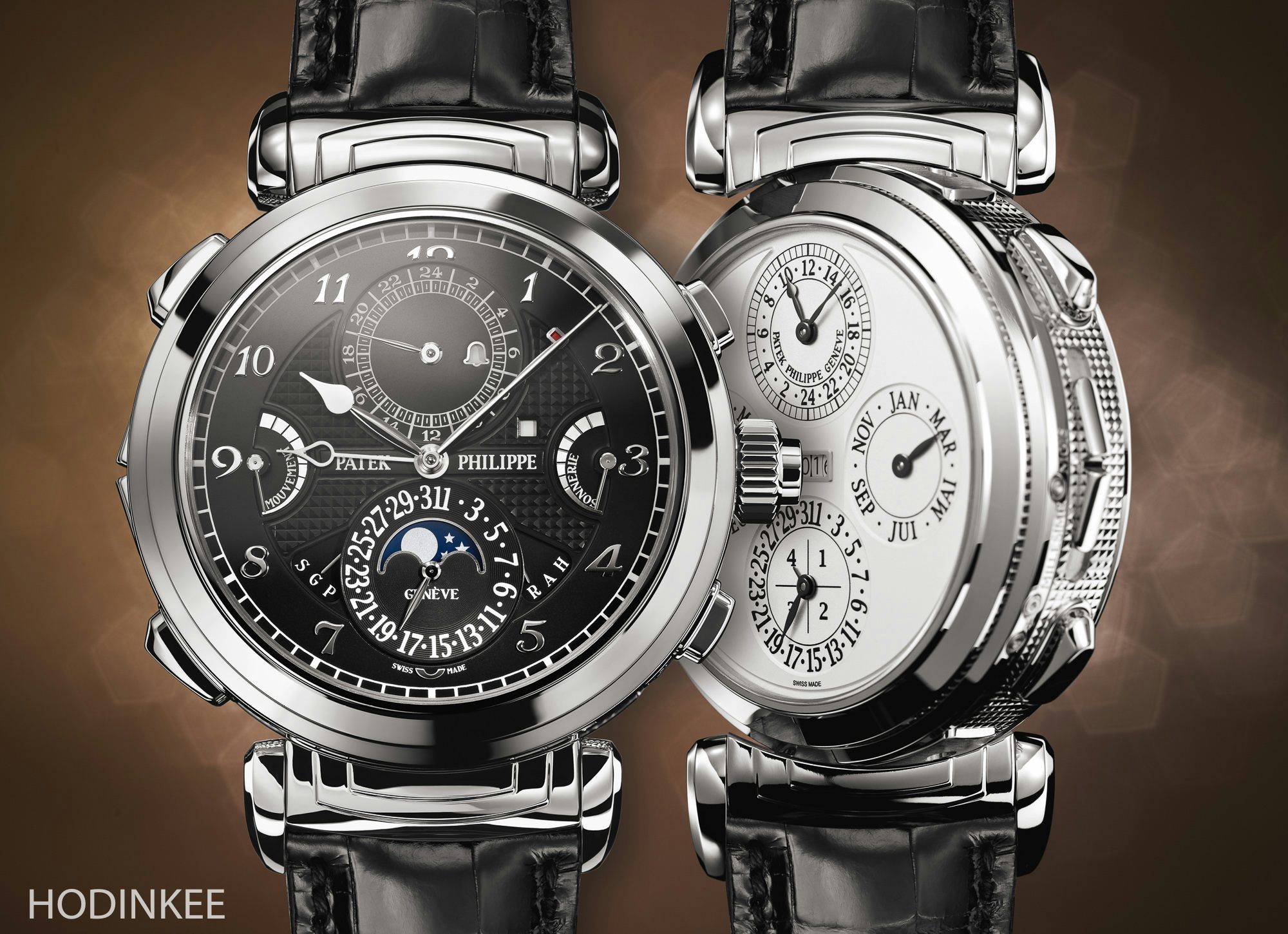
Patek Philippe Grandmaster Chime Grand Complication
No. 01 — The Most Expensive Wristwatch Ever Sold
Patek Philippe

Grandmaster Chime
Ref. 6300A "Only Watch"

In November 2019, a unique stainless steel Patek Philippe Grandmaster Chime sold at the Only Watch charity auction in Geneva for CHF 31,000,000 — approximately $31 million. This is the most expensive wristwatch ever sold at auction. The buyer has never been identified. The proceeds funded research for Duchenne Muscular Dystrophy. The watch has 20 complications. Its movement contains 1,366 components. Development required approximately 100,000 working hours — enough for one person to work continuously for 50 years. Patek wrote a 200-page technical manual for it. The standard white gold production version costs approximately $2.6 million. This steel version was the only one ever made. It will never be made again. The inscription on the alarm subdial reads: "The Only One."

Complications20 (Patek Philippe record)
Movement parts1,366 components
Case47.7mm Stainless Steel
Development time~100,000 hours

One watch. One auction. One night in Geneva. The gavel came down at CHF 31 million. The buyer's identity remains unknown. The inscription reads "The Only One." It is.
"

The Paul Newman Daytona sold for $17.75 million in 2017. Newman wore it for decades as a daily watch. His wife bought it for him as a gift. She paid approximately $50.

— Phillips New York, October 26, 2017

Auction record
$17,752,500
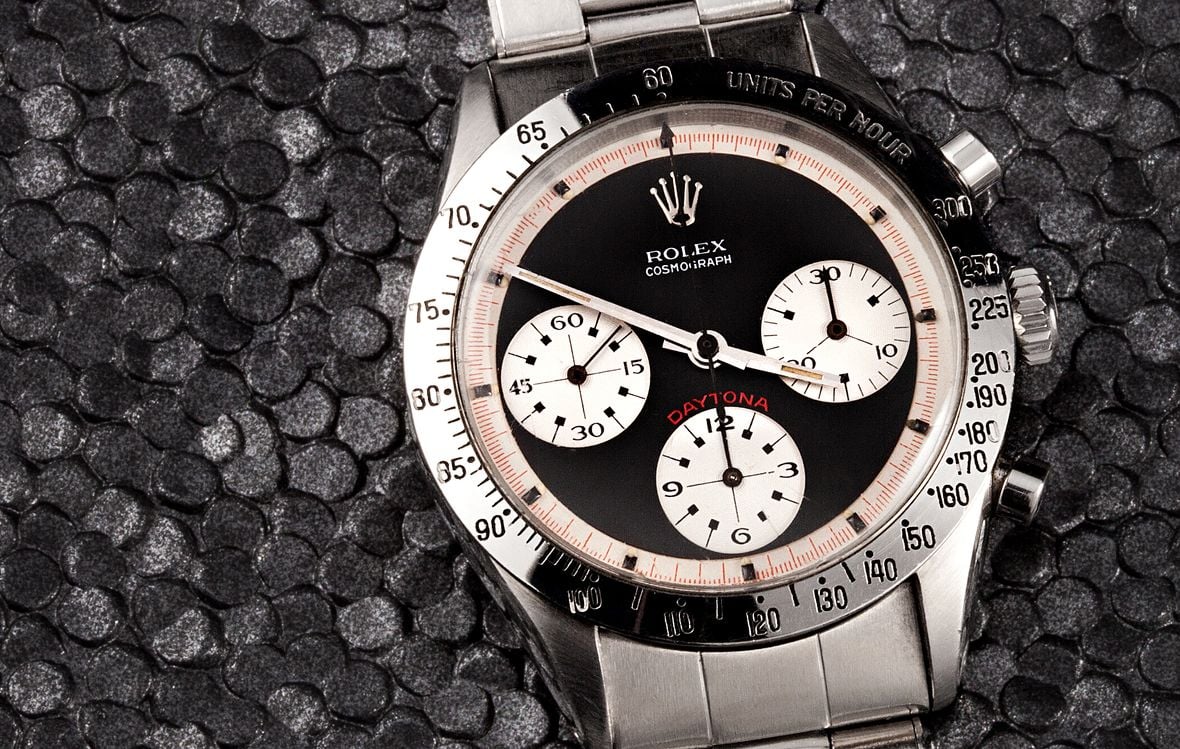
Rolex Paul Newman Daytona Reference 6239
No. 02 — The Most Famous Watch in the World
Rolex

Cosmograph Daytona
Paul Newman's Ref. 6239

Joanne Woodward gave Paul Newman a Rolex Daytona Ref. 6239 in the early 1970s. Engraved on the caseback: "Drive Carefully. Me." He wore it for decades — on film sets, at the wheel of race cars in actual competition, in thousands of photographs. In 2017, his daughter sold it at Phillips in New York. The hammer fell at $17,752,500, setting the world auction record for a wristwatch at the time. The buyer was James Cox, producer of The Late Late Show with James Corden. The watch that defined an entire category of Rolex collector references — the "Paul Newman dial" Daytona — had been acquired new for approximately $50. No object in the history of collecting better illustrates what biography does to an object, and how the market has learned to price that biography.

Reference6239 (circa 1968)
Original price~$50
MovementValjoux 722 manual-wind
2017 auction result$17,752,500

"Drive Carefully. Me." — engraved by Joanne Woodward. She paid $50. Her daughter sold it for $17.75 million. The watch was the same. Everything else had changed.

Retail price
~$450,000
A. Lange & Söhne Tourbograph Perpetual Pour le Mérite
No. 03 — Germany's Greatest Complication
A. Lange & Söhne

Tourbograph Perpetual
Pour le Mérite

The "Pour le Mérite" name references Prussia's highest military honour — given here to the movement because it uses a fusée-and-chain transmission. A chain of 636 individually hand-finished links, each 0.18mm wide, transfers mainspring power to the gear train with absolute consistency regardless of how wound the spring is. Building one chain takes a master watchmaker an entire day under magnification. There are perhaps a dozen people on earth qualified to do it. Around this chain, Lange places three of watchmaking's most demanding complications: a tourbillon to compensate for gravity, a split-seconds rattrapante chronograph to time overlapping events, and a perpetual calendar that knows the length of every month until 2100. Every component is hand-finished in Glashütte. Every movement is built twice.

ComplicationsTourbillon + Rattrapante + Perpetual
Chain636 links, each 0.18mm wide
Case41.9mm Pink Gold
FoundedGlashütte, 1845

636 chain links, each finished by hand, assembled under magnification: one chain per day. No faster way exists. No faster way will ever exist. The price reflects that fact exactly.

"

Richard Mille set out to build a watch that could survive a Formula 1 crash. He succeeded. He then priced it such that the watch costs considerably more than the car.

— On the Richard Mille philosophy, est. 2001

Retail price
~$175,000–$220,000
Richard Mille RM 11-03 McLaren Automatic Flyback Chronograph
No. 04 — The Racing Machine on a Wrist
Richard Mille

RM 11-03
McLaren Flyback Chronograph

Richard Mille founded his brand in 2001 with one explicit goal: build a watch that would survive being strapped to Rafael Nadal's wrist during a Grand Slam final. The RM 11-03 extends that philosophy to motorsport. The case is NTPT Carbon — aerospace-grade composite, layers of carbon fibre filaments each 30 microns thick, processed in an autoclave at 120°C under 6 bars of pressure, then individually machined by hand. The movement is fully skeletonised and visible from every angle. Every tolerance is measured in microns. The watch withstands 5,000Gs of shock. Jay-Z, Rafael Nadal, and a significant portion of the Formula 1 paddock have worn Richard Milles — not because they need 5,000G shock resistance, but because nothing else exists at the intersection of this level of engineering and this level of presence.

Case materialNTPT Carbon / Titanium
MovementAuto Flyback Chrono RMAC3
Shock resistance5,000G
CollaborationMcLaren Automotive

The RM 11-03 case is machined from aerospace composite. The movement tolerances are measured in microns. The price is $200,000. It sells at retail on a waiting list. This is what happens when engineering has no budget ceiling.

Retail price
~$150,000–$200,000
Audemars Piguet Royal Oak Extra-Thin Tourbillon
No. 05 — The Original Luxury Sport Watch, Elevated
Audemars Piguet

Royal Oak
Tourbillon Extra-Thin

Gérald Genta drew the Royal Oak in 1972 — an octagonal bezel with eight exposed screws, an integrated bracelet, and a steel case priced more expensively than gold. It was an act of deliberate provocation against the Swiss establishment. AP makes the Royal Oak at their manufacture in Le Brassus, where the same valley, the same families, have worked since 1875. The Tourbillon Extra-Thin adds AP's in-house flying tourbillon: a cage containing balance wheel and escapement, rotating once per minute, the most beautiful purely mechanical sight in all of watchmaking, visible through the Grande Tapisserie-patterned sapphire dial. The case is 6.3mm thin with the tourbillon inside it. The engineering required to achieve that proportion with that complication represents decades of accumulated knowledge. The gavel on the entry-level Royal Oak currently sits at around $30,000. The tourbillon version is where that design language reaches its apex.

ComplicationFlying Tourbillon
Case thicknessUltra-thin with tourbillon inside
MovementCal.2924 (In-House)
DesignGérald Genta, 1972

The tourbillon cage rotates once per minute, visible through the Grande Tapisserie dial. Genta drew this case in 1972. Audemars Piguet has never found reason to alter it. Some designs are simply correct from the beginning.

"

Vacheron Constantin has been making watches without interruption since 1755. Through wars. Revolutions. The replacement of every political order in Europe. The watches continued.

— Vacheron Constantin, founded Geneva 1755

Bespoke — from
~$500,000+
Vacheron Constantin Les Cabinotiers Grand Complication
No. 06 — The Art of the One-of-One
Vacheron Constantin

Les Cabinotiers
Bespoke Haute Horlogerie

Les Cabinotiers is Vacheron Constantin's programme for commissions where no catalogue exists. A client approaches with a wish — an astronomical complication tied to a personal date, a case shape that has never been produced, an engraved narrative that spans the entire movement architecture. The atelier responds not with available options but with a design drawn from nothing. The name references Geneva's 18th-century independent watchmakers — "cabinotiers" — who worked in top-floor studios where northern light made the fine work possible. Vacheron Constantin has made watches without interruption since 1755 — longer than the United States has existed. Through the Napoleonic Wars, the French Revolution, two world wars, and the complete redesign of European borders, the watches in Geneva continued. Les Cabinotiers exists because after 270 years, the manufacture still believes the finest watch is the one that has never been made before.

ProgrammeBespoke one-of-a-kind commission
FoundedGeneva, 1755
OutputUnique pieces only
PriceBy commission only

There is no price list. There is no catalogue. There is only the question: what do you want built? Vacheron Constantin — continuous since 1755 — decides whether it can be done.

Retail price
~$100,000–$145,000
F.P. Journe Tourbillon Souverain Remontoir
No. 07 — The Independent's Masterpiece
F.P. Journe

Tourbillon Souverain
Remontoir d'Égalité

François-Paul Journe built his first tourbillon by hand at age 20 as a school project. He opened his Geneva manufacture in 1999, having already spent two decades as the most admired movement maker working anonymously for other brands. The Tourbillon Souverain Remontoir adds a constant-force mechanism to the tourbillon: a remontoir spring rewound every 1.5 seconds, delivering identical impulse energy to the escapement regardless of mainspring tension. This eliminates the primary cause of rate variation in mechanical watches. Every Journe movement is made in-house, signed, numbered, and cased exclusively in gold or platinum — he considers steel insufficiently respectful of the movement it houses. Production is constrained by what his watchmakers can build by hand. The waiting list is measured in years. He does not expand production to reduce the wait. He considers the wait appropriate.

ComplicationsTourbillon + Remontoir
Case38mm Rose Gold or Platinum
FoundedGeneva, 1999
Signed byF.P. Journe personally

Journe does not make steel watches. He considers steel disrespectful to the movement. Every watch is signed by his hand. He cannot sign more than he can sign. He does not consider this a problem.

Secondary market
$80,000–$150,000+
Patek Philippe Nautilus 5711 Stainless Steel Blue Dial
No. 08 — The Most Wanted Steel Watch on Earth
Patek Philippe

Nautilus
Ref. 5711/1A — Discontinued 2021

In January 2021, Patek Philippe announced the discontinuation of the Nautilus 5711 in stainless steel — the blue-dialled version that Gérald Genta sketched on a napkin in 1976. Within hours of the announcement, secondary market prices doubled. Dealers who had been selling them at minor premiums above retail began fielding calls for $100,000+. Patek discontinued the watch specifically because demand had become "unhealthy" — customers were purchasing directly to sell immediately at a profit, which Patek considered contrary to the spirit of watchmaking. The market's response demonstrated the precise magnitude of the mistake. The Nautilus 5711 was not the most complicated watch Patek made. It was not the most expensive. It was simply the most wanted. The 5711 is the clearest illustration in modern watchmaking of what "unlimited desire meeting zero supply" actually produces.

Reference5711/1A (2006–2021)
Original retail~$35,000
Cal.26-330 S CMovement
StatusDiscontinued Jan. 2021

Patek discontinued the 5711 because demand was "unhealthy." Secondary market prices immediately hit $150,000+. The napkin sketch from 1976 is still the most wanted watch on earth. Some ideas are simply correct, forever.

The Spectrum — Eight Watches, One Scale
Nautilus
5711
$80K–$150K
Journe
Tourbillon
~$145K
AP Royal Oak
Tourbillon
~$200K
Richard
Mille
~$200K
Lange
Tourbograph
~$450K
Vacheron
Cabinotiers
$500K+
Paul Newman
Daytona
$17.75M
Grandmaster
Chime
CHF 31M

What makes a watch worth a million dollars?

The honest answer is: nothing rational, and everything that matters. A $10 Casio measures time more accurately than every watch on this page. The quartz crystal inside a supermarket watch maintains timekeeping precision that the most expensive mechanical chronometer cannot approach. Accuracy is not what any of this is about.

The Lange Tourbograph chain has 636 links. Each is hand-finished. Assembly takes a master watchmaker a full day under magnification. There is no faster way. That constraint is not a problem to be engineered around — it is the entire point. The constraint is the value.

The Paul Newman Daytona cost $50 new. Newman wore it for decades — on film sets, at the wheel of race cars he drove in actual competition, at dinner with his wife, in thousands of photographs. His daughter sold it in 2017 for $17.75 million. The watch itself hadn't changed. A human life had passed through it, and the market had learned to price that passage.

These are not accurate timekeepers. They are the physical record of what happens when extraordinary skill, extraordinary patience, and extraordinary material meet a specific human ambition: to build something that cannot be built any other way, by any other hands, in any other place, in any other moment of history.

The price is the number the market puts on irreplaceability. The irreplaceability itself is older than money, and it doesn't need the price to be real.

← $10K–$20K Watches $5K–$10K Watches Best Rolex Watches All Price Ranges
This page contains no affiliate links. All watches are presented for editorial purposes only. Images sourced from public archives and media. Prices quoted are approximate and subject to significant change — secondary market values in particular fluctuate considerably. Always verify current pricing with authorised dealers or reputable auction houses.